The documents for university admission in Turkey come in two rounds. To apply, you usually upload scans: passport, photo, full high school transcript, diploma if you have it, and any test results. To register, you bring originals with an apostille or consular legalisation, sworn translations, and the Ministry of Education’s equivalence certificate (denklik) or proof of its appointment. Most delays come from leaving the second round too late.
Most students who contact us about documents for university admission in Turkey are not worried about the passport copy. They are worried about the parts nobody explains clearly: which papers need an apostille, whether a translation has to be sworn, what “denklik” is and when it is due, and what happens if something is missing on registration day. This guide answers those questions using the published rules of Istanbul universities, checked on 21 November 2026.
If you have not chosen your universities yet, start with our step-by-step guide on how to apply to universities in Istanbul. This page focuses only on the paperwork.
Which documents for university admission in Turkey do you need, and when?
There is no central application system for international students in Turkey, so each university publishes its own list. The lists are similar, but the details (which test, how many reference letters, whether a translation must be notarised) differ. Read the list on each university’s international admissions page, and keep a single folder per university.
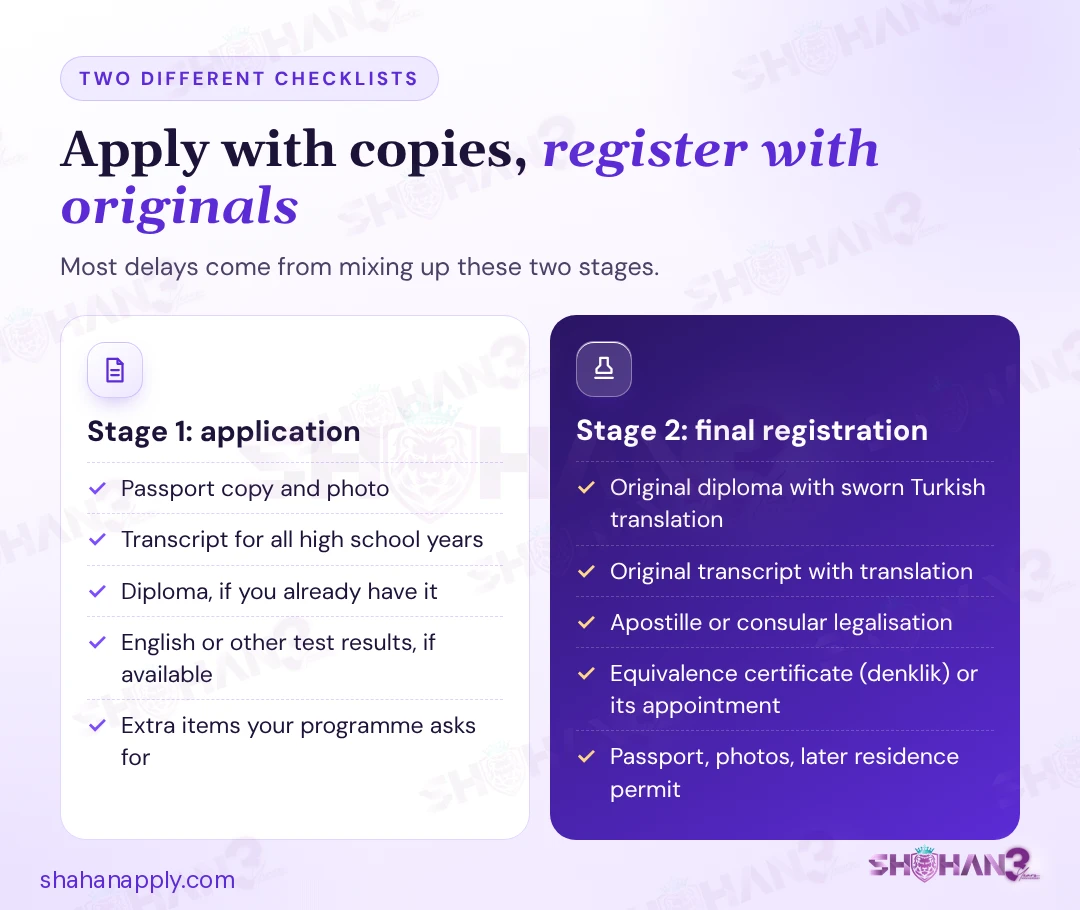
| Stage 1: application | Stage 2: final registration |
|---|---|
| Passport copy and photo | Original diploma with sworn Turkish translation |
| Transcript for all high school years | Original transcript with translation |
| Diploma, if already issued | Apostille or consular legalisation |
| English or other test results, if available | Equivalence certificate (denklik) or its appointment |
| Programme extras (letters, portfolio) | Passport, photos, later residence permit |
What do you upload when you apply?
For an undergraduate application, published lists at Acıbadem and Bahçeşehir share the same core: a passport or national ID copy, a photo, the high school diploma if you have it, transcripts covering every year with grades, and English test results if available. Bahçeşehir adds SAT, AP, A-level, IB or other international qualifications where you have them, and lets students still in high school apply with their current transcript and send the diploma later.
Some programmes ask for more. Acıbadem asks for a letter of intent and a reference letter, and two references from mathematics, biology or chemistry teachers for medicine. It also asks for notarised translations of any document that is not in English or Turkish, and states that applications with missing documents will not be considered.
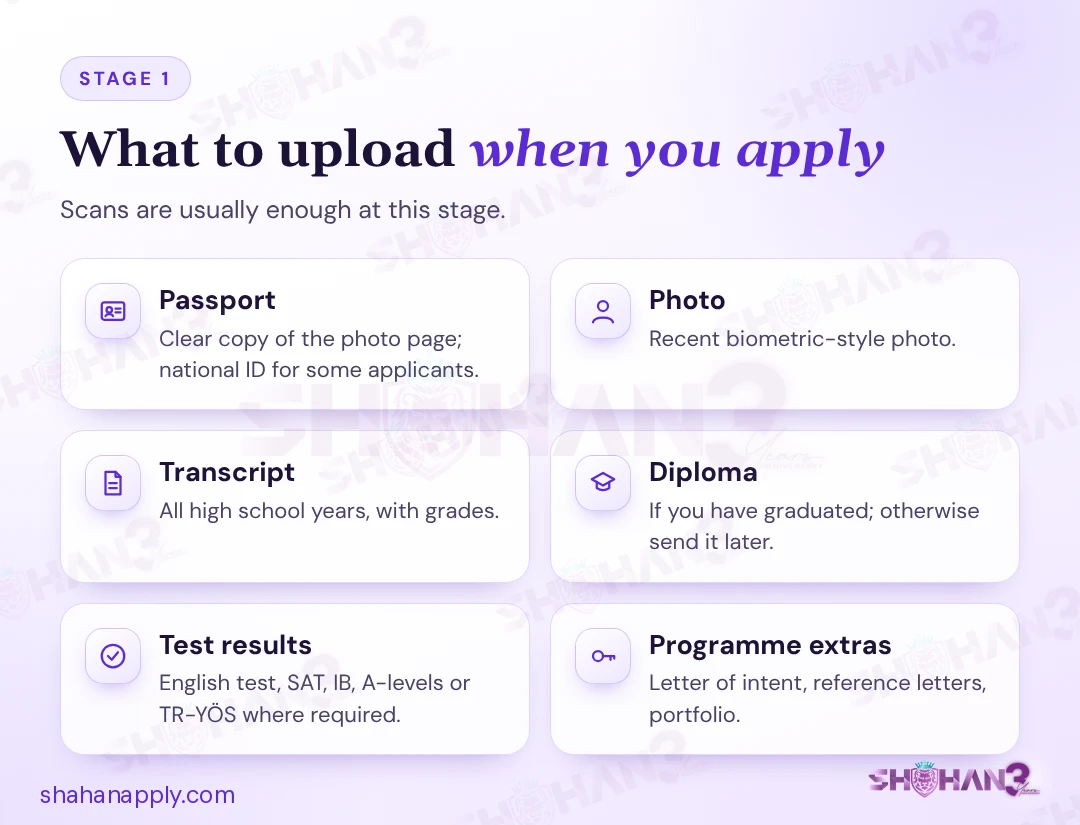
| Document | Notes |
|---|---|
| Passport | Photo page copy; national ID for some applicants |
| Photo | Recent, biometric style |
| Transcript | Every high school year, with grades |
| Diploma | If graduated; otherwise send later |
| Test results | English test, SAT, IB, A-levels or TR-YÖS where required |
| Programme extras | Letter of intent, references, portfolio |
What do you bring to final registration?
Registration is where the originals matter. Bezmialem’s published enrolment list is a good example: original diploma with a notarised Turkish translation, the equivalence certificate, original transcript with translation, exam result documents, passport copy, two photos, a residence permit to be delivered within three months of registration, and for Turkish-taught programmes a Turkish certificate from TÖMER or the Yunus Emre Institute.
Your admission letter will state what your university wants. If it lists something you do not have, ask in writing before you travel, not at the registration desk.
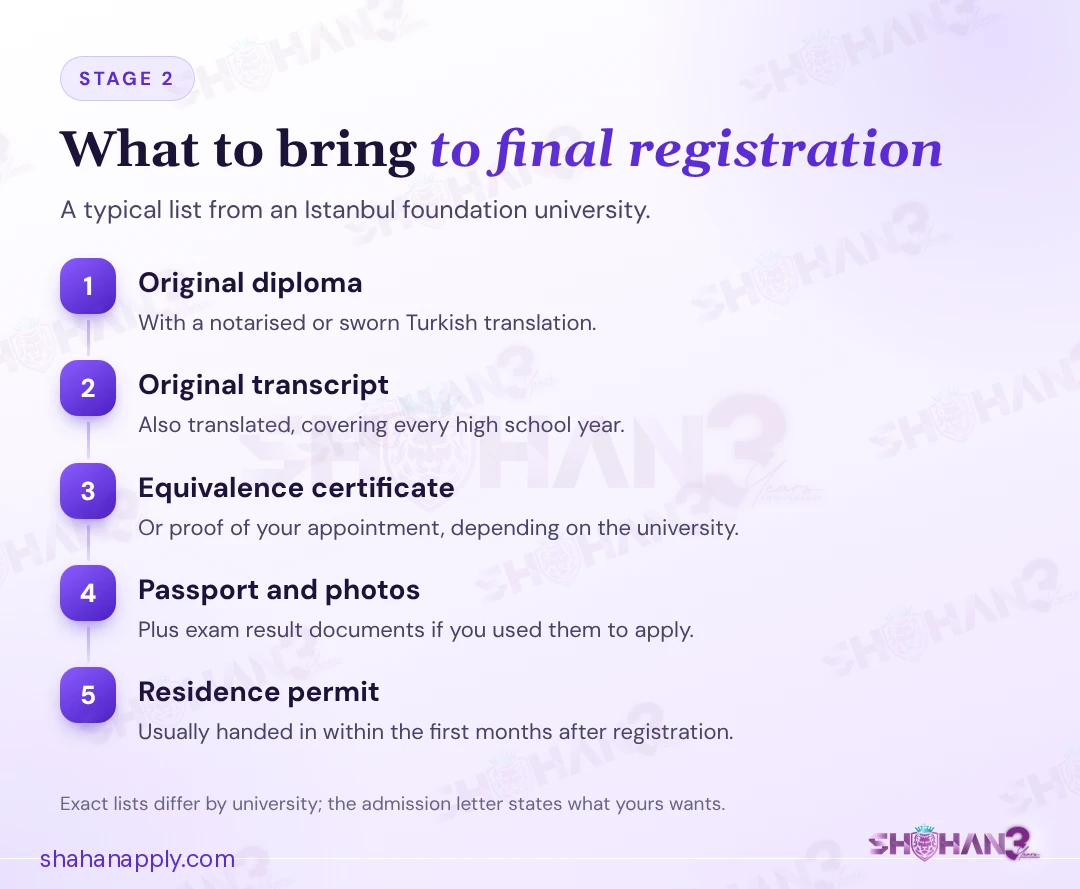
| # | Document | Notes |
|---|---|---|
| 1 | Original diploma | With notarised or sworn Turkish translation |
| 2 | Original transcript | Translated, every high school year |
| 3 | Equivalence certificate | Or appointment proof, depending on the university |
| 4 | Passport and photos | Plus exam result documents |
| 5 | Residence permit | Usually within the first months |
Apostille or consular legalisation: which do you need?
It depends on the country that issued your diploma. If that country is a party to the Hague Apostille Convention, the diploma and every transcript need an apostille from the authority your country designates. Okan describes this as mandatory for convention countries. If your country is not a party, the documents are certified by your education ministry, then your foreign ministry, and then approved by the Turkish embassy or consulate.
Check your country on the HCCH status table before booking anything. A common mistake is to apostille the diploma but not the transcripts; both are needed.
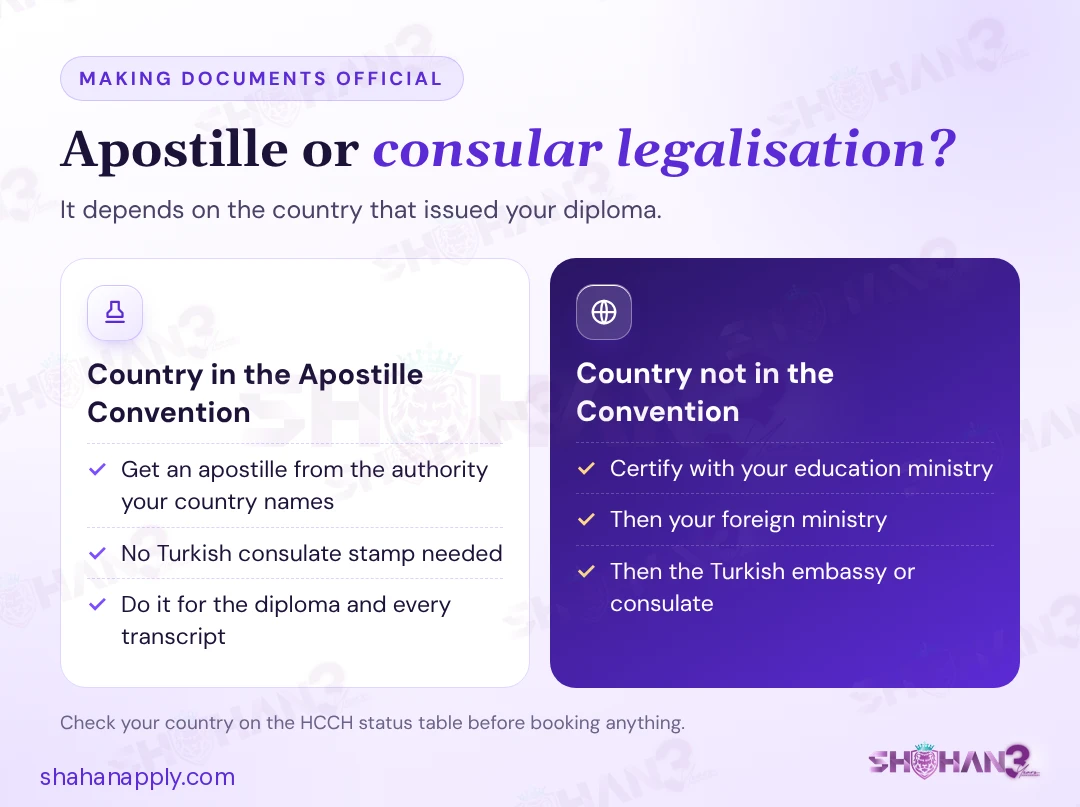
| Your country | What to do |
|---|---|
| Party to the Apostille Convention | Apostille on the diploma and every transcript; no consulate stamp needed |
| Not a party | Education ministry, then foreign ministry, then Turkish embassy or consulate |
What is denklik and when do you need it?
Denklik is the high school equivalence certificate issued by Turkey’s Ministry of National Education (MEB). It confirms that your foreign diploma counts as a Turkish high school diploma. For international undergraduate students it is a registration document, not usually an application document, though a few state universities ask for it earlier.
You start on the MEB e-Denklik portal, receive an appointment, and attend with your file at a Turkish consulate abroad or, in Istanbul, at the Provincial Directorate of National Education. Koç lists the file as the original diploma and transcripts with copies, passport pages including your entry stamp, a signed form and a copy of your admission letter. For country-specific rules, see our page on diploma equivalence in Turkey.
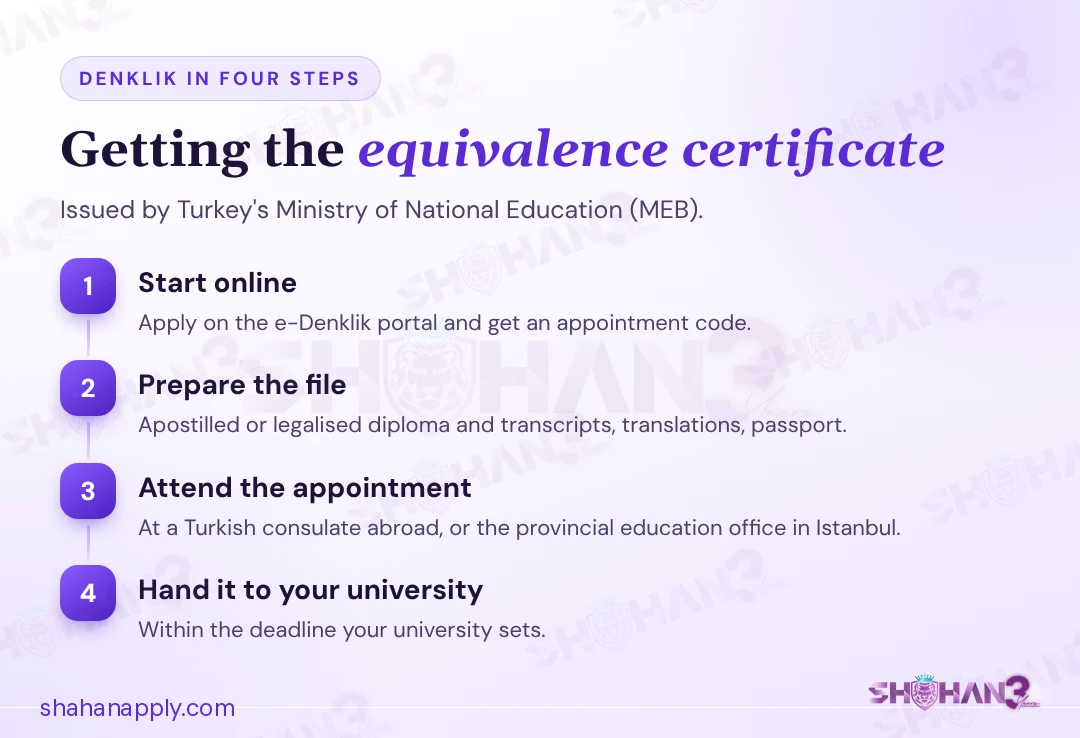
| Step | What happens |
|---|---|
| 1. Start online | Apply on e-Denklik and get an appointment code |
| 2. Prepare the file | Legalised diploma and transcripts, translations, passport |
| 3. Attend the appointment | Turkish consulate abroad or provincial education office in Istanbul |
| 4. Submit to your university | Within the deadline the university sets |
How long do you have?
Deadlines differ. Okan asks for a copy of your MEB appointment paper within 10 days of registration and gives three months after registration to submit the certificate. Koç says registration will not be held without the certificate or the online appointment. Haliç asks for it within the document period set for international students. Nişantaşı strongly advises students abroad to finish the process before travelling.
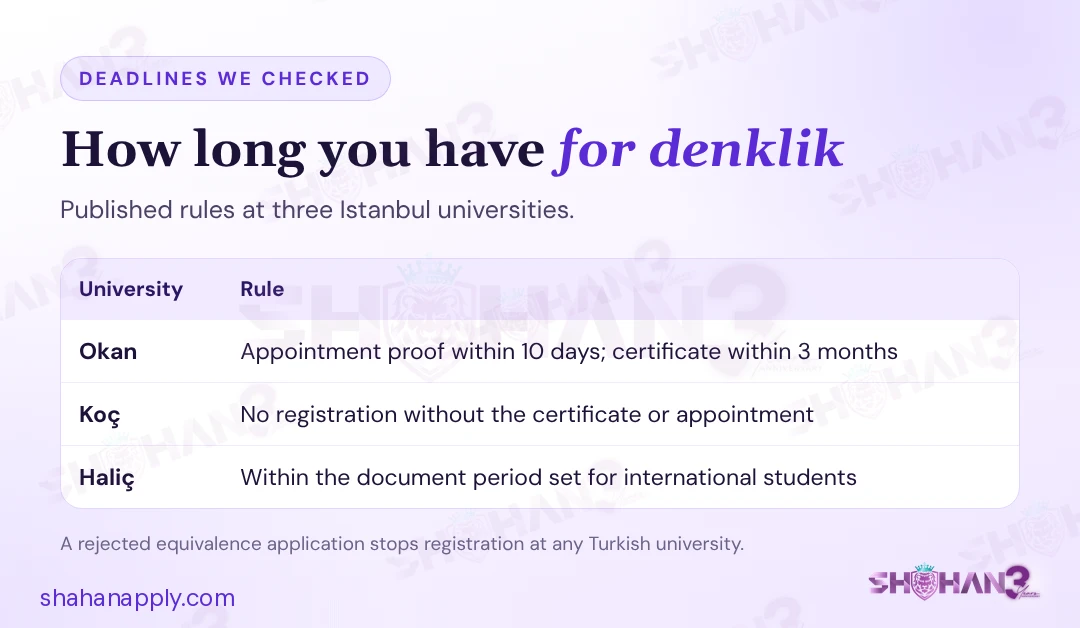
| University | Rule |
|---|---|
| Okan | Appointment proof within 10 days; certificate within 3 months of registration |
| Koç | No registration without the certificate or the online appointment |
| Haliç | Within the document period for international students |
Do your documents need a sworn translation?
For the application, many Istanbul universities accept documents in English or Turkish as they are. Anything in another language needs a notarised or sworn translation. For denklik, rules vary by office: Okan’s guidance says a translation is needed unless the document is in Arabic, English, German or French, with conditions. Registration lists such as Bezmialem’s ask for a notarised Turkish translation of the diploma and transcript regardless.
A simple translation from a friend or an unofficial service is not enough. If you are already in Istanbul, our sworn translation service in Istanbul prepares documents in the format universities and MEB offices accept.
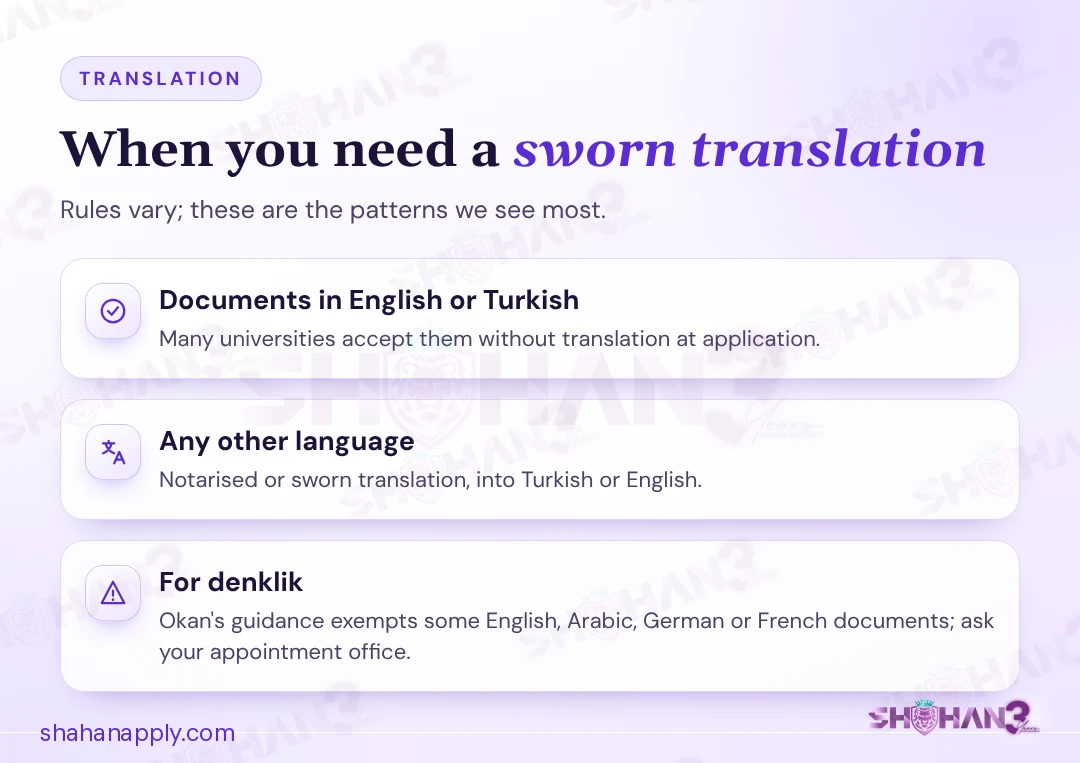
| Situation | Usual rule |
|---|---|
| Documents in English or Turkish | Often accepted as they are at application |
| Any other language | Notarised or sworn translation into Turkish or English |
| Denklik and registration | Turkish translation often required; some offices exempt certain languages |
Check your own document plan
Answer four questions and the checker builds your personal list. It does not replace your university’s list, but it shows which of the hard parts apply to you.
Worked example: a student from a non-Apostille country
Hypothetical example. Let’s say Reza finishes high school in Iran in June and wants to start an English-taught engineering degree in Istanbul in September. Iran was not listed as a party to the Apostille Convention when we checked, so his documents follow the consular route.
- April: he applies to two universities with his passport scan, photo and transcripts for the first three years.
- June to July: once the diploma is issued, he has it certified by the education authority and the foreign ministry, then approved by the Turkish consulate, and orders sworn translations.
- July: he starts the e-Denklik application and books his appointment, then applies for the student visa with his acceptance letter.
- September: he registers with originals, gets health insurance, and applies for his residence permit before his visa expires.
The reason this order works: the slowest steps (legalisation and denklik) start the moment the diploma exists, not after he arrives. If he waited until September, a single missing consulate stamp could push his registration into the next semester.
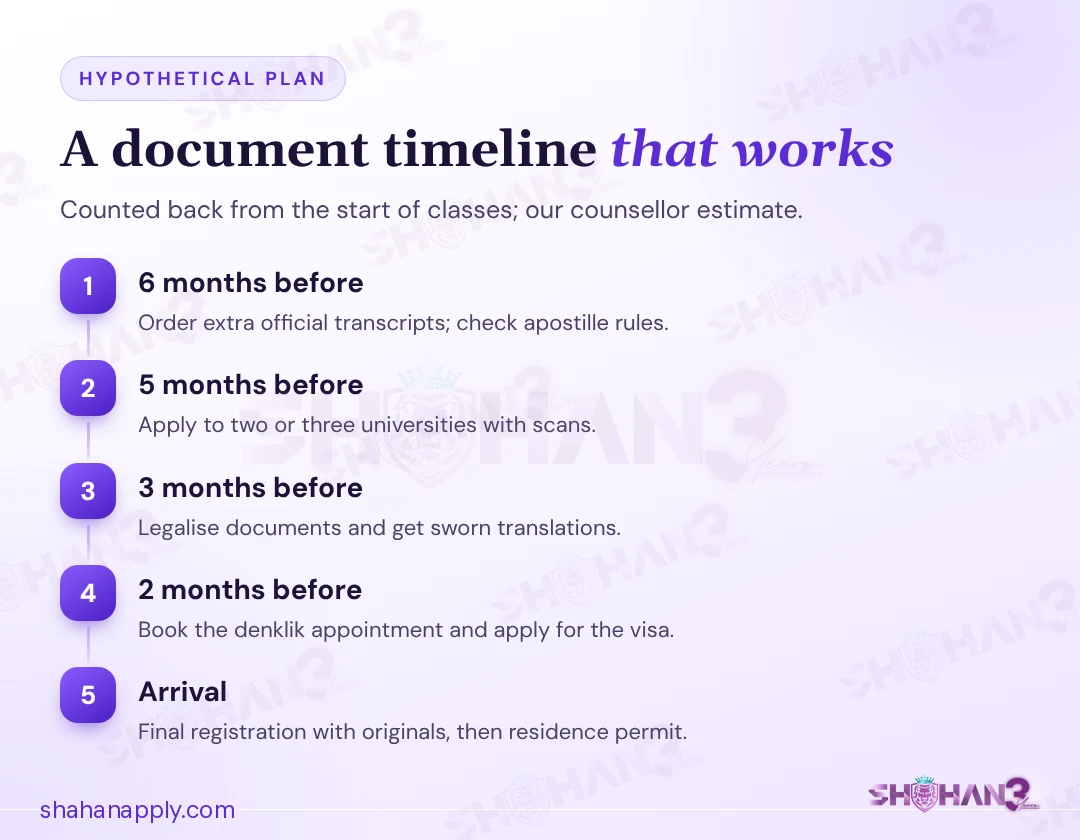
| When | What to do |
|---|---|
| 6 months before | Order extra official transcripts; check apostille rules |
| 5 months before | Apply to two or three universities with scans |
| 3 months before | Legalise documents; get sworn translations |
| 2 months before | Book denklik; apply for the student visa |
| Arrival | Final registration with originals; residence permit |
Which documents do you need after admission?
The paperwork continues after the offer letter. You apply for a student visa at the Turkish consulate with your acceptance letter. After registration, you apply for a student residence permit before the visa expires; Haliç notes that student visas usually run from one month to 90 days and that processing can take up to 90 days. You will need valid health insurance for that application.
We help with both steps: see our pages on the student residence permit in Turkey and student health insurance.
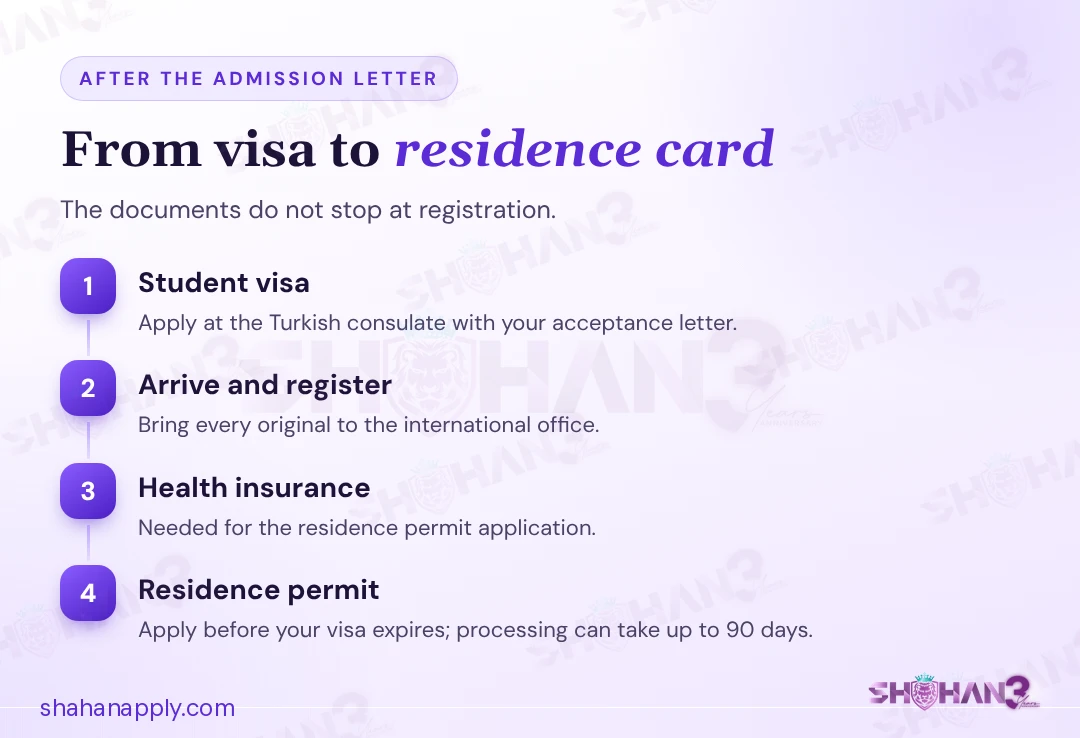
| Step | Key document |
|---|---|
| Student visa | Acceptance letter and consulate forms |
| Registration | All originals and translations |
| Health insurance | Policy valid in Turkey |
| Residence permit | Application before the visa expires; up to 90 days processing |
Which mistakes delay registration most?
Most of the delays we see are avoidable. Your name must be spelled the same way on the passport, diploma and transcript; a different transliteration can stop a denklik file. Transcripts must cover every high school year, not only the final one. And originals must travel with you, because universities register from originals, not scans.
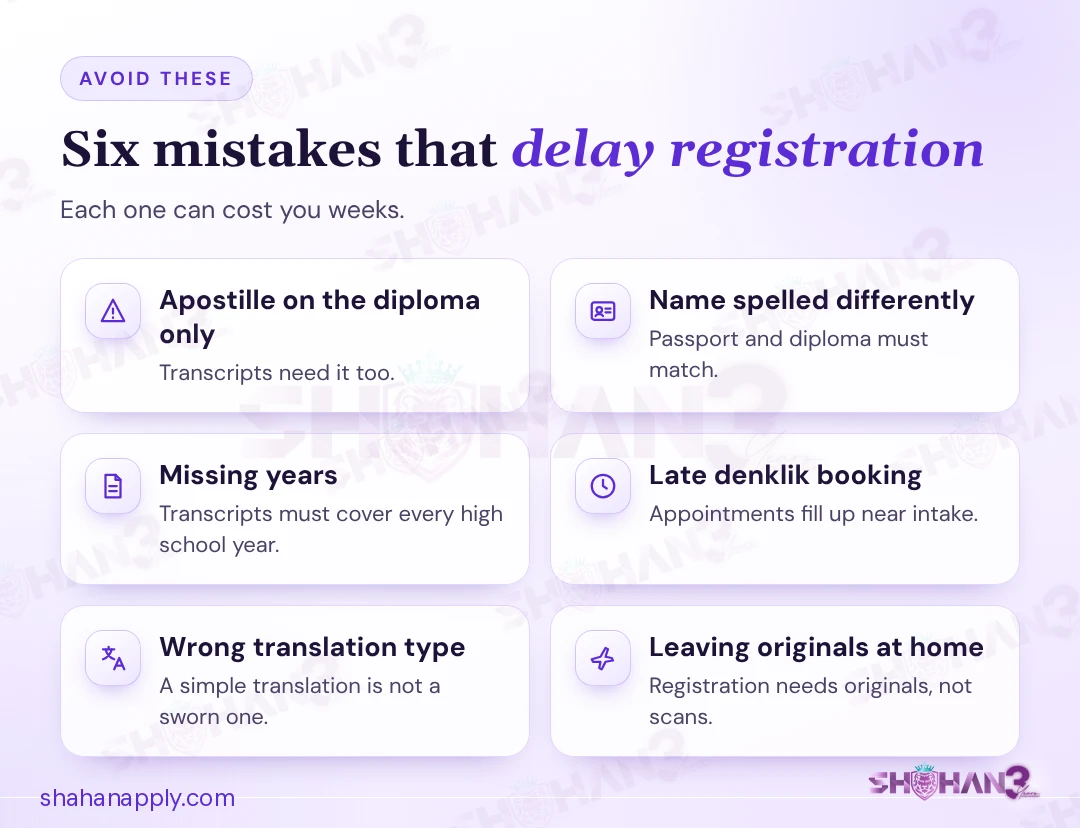
| Mistake | Fix |
|---|---|
| Apostille on the diploma only | Apostille the transcripts too |
| Name spelled differently | Match passport spelling or get an official note |
| Missing years | Transcript for every high school year |
| Late denklik booking | Book as soon as the diploma is issued |
| Wrong translation type | Use a sworn or notarised translator |
| Originals left at home | Carry all originals to registration |
Is it too late to apply for the next intake?
Not always. Some Istanbul universities run a spring intake: Bahçeşehir’s page says applications were extended until 30 November 2026, with spring classes starting on 18 January 2027. If you are aiming for spring, start the legalisation and translation now, because the documents for university admission in Turkey take longer than the application itself. Fees vary widely by programme; for example, see our guide to dentistry in Istanbul in English, or browse private universities in Istanbul.
Frequently asked questions
What documents are required for university admission in Turkey?
For the application: passport, photo, full high school transcript, diploma if issued, and test results where required. For registration: originals with apostille or legalisation, sworn translations, and the denklik equivalence certificate.
Do I need an apostille for Turkish universities?
If your country is a party to the Apostille Convention, yes, on the diploma and transcripts. If not, you need consular legalisation through the Turkish embassy or consulate.
What is denklik in Turkey?
It is the high school equivalence certificate from the Ministry of National Education. International undergraduate students usually need it to register, and you start the process on the e-Denklik portal.
Can I apply before I receive my high school diploma?
Yes, at many universities. Bahçeşehir, for example, accepts your current transcript and asks for the diploma after graduation.
Do I need a sworn translation if my documents are in English?
Usually not for the application. For denklik and registration some offices still ask for a Turkish translation, so check your university’s list.
How long does the residence permit take for students?
Haliç notes that processing can take up to 90 days. You must apply before your student visa expires.
Your plan for today
- Check whether your country is a party to the Apostille Convention.
- Order extra official copies of your transcript for every high school year.
- Compare your passport, diploma and transcript spellings letter by letter.
- Open each university’s document list and save it in its own folder.
- Run the readiness checker above and note which steps take longest for you.
Still unsure about the documents for university admission in Turkey? Ask for an eligibility and university shortlist review. Want the wider picture? Read our Istanbul application guide, see medicine in Istanbul in English, check tuition fees at Istanbul universities, or visit the study in Turkey FAQ and the Shahan Apply homepage.
Check the fee for your programmeMessage us on WhatsAppFree eligibility review
Sources
- Acıbadem, how to apply (undergraduate)
- Bahçeşehir, applications and required documents
- Bezmialem, documents for enrolment
- Okan, equivalency certificate
- Koç, equivalency letter for registration
- Nişantaşı, high school equivalency certificate
- Haliç, documents after registration
- Ministry of National Education, e-Denklik portal
- HCCH, Apostille Convention status table
Rules checked on 21 November 2026. Document lists and deadlines change; confirm every requirement with your university in writing. Shahan Apply does not guarantee admission, equivalence decisions, visas or residence permits.