Istanbul has more than 50 universities, and most of them are private. Private universities in Istanbul are what Turkey officially calls foundation (vakıf) universities: non-profit, fee-paying and regulated by the same higher-education law as state universities. For an international student they are usually the realistic route into an English-taught degree in Istanbul, because they admit on your high-school results rather than a national exam, publish clear intakes and offer international discounts.
Annual bachelor’s tuition at private universities in Istanbul runs from under $3,000 at the budget end to $40,000+ for English-taught medicine or dentistry. The right choice depends less on rankings and more on four things: your programme’s language, your full-degree budget, the university’s stability, and what you plan to do after graduating.
Compare current fees programme by programme or ask us for a free shortlist review.
Let’s say you have just finished high school in Amman, Tehran, Lagos or Almaty. Your family can cover a reasonable tuition bill, you want to study in English, and private universities in Istanbul keep coming up in your searches. Within ten minutes you will find lists of “the best private universities in Istanbul”, each ranking the same names in a different order and very few explaining how to actually pick one.
This guide to private universities in Istanbul is written the way we would talk it through with you in our office. We will explain what a private university in Turkey really is, what it costs in practice, how admission works, which risks are worth checking before you pay a deposit, and how to narrow 40-plus options down to a shortlist of three. You will also find a quick budget tool, a deposit checklist and a worked example.
What does “private university” mean in Turkey?
Turkish law describes these institutions as vakıf üniversiteleri. According to the European Commission’s Eurydice profile of Türkiye, foundation universities are financed by the fees they receive from students on a non-profit basis, and they follow the same legal regulations as public universities apart from some administrative and financial matters. In plain terms, a diploma from a foundation university is a Turkish university diploma, not a lesser certificate.
What differs is how you get in and what you pay. State universities in Istanbul, such as Istanbul University or Istanbul Technical University, admit international students through competitive quotas and often require exams such as YÖS or SAT. Foundation universities, including every one of the private universities in Istanbul, set their own international admission criteria, and most will assess you on your school diploma and transcript.
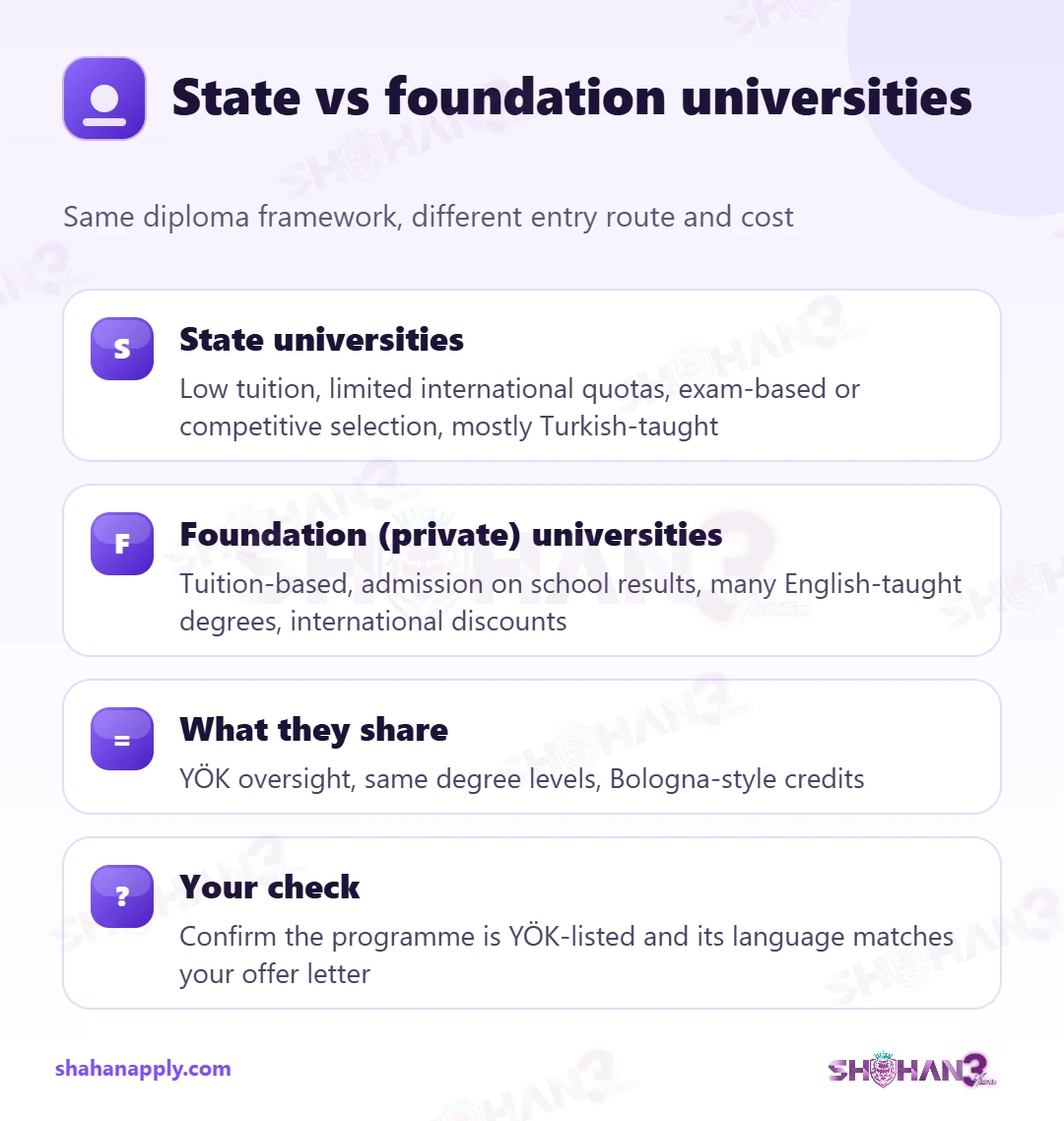
| Topic | State universities | Foundation (private) universities |
|---|---|---|
| Tuition | Low | Tuition-based, international discounts |
| International admission | Limited quotas, exam-based or competitive | Mostly on school diploma and grades |
| Language | Mostly Turkish-taught | Many English-taught degrees |
| Oversight | YÖK | YÖK |
How many seats do private universities offer, and why it matters to you
For the 2026 placement cycle, YÖK reported 602,117 places at state universities and 184,914 at foundation universities, as covered by Daily Sabah. Foundation universities are therefore a smaller slice of the system, yet they host a large share of international students because they actively recruit abroad.
There is a second number that tells you something useful about bargaining power. Hürriyet Daily News reported that in the 2026 placements, 35,706 of 176,080 formal foundation-university seats stayed empty, roughly one in five, while state universities were almost full. When seats are empty, private universities in Istanbul and across Turkey compete for students. That is one reason you see early-payment discounts and international scholarships, and it is a good reason not to accept the first price you are quoted.
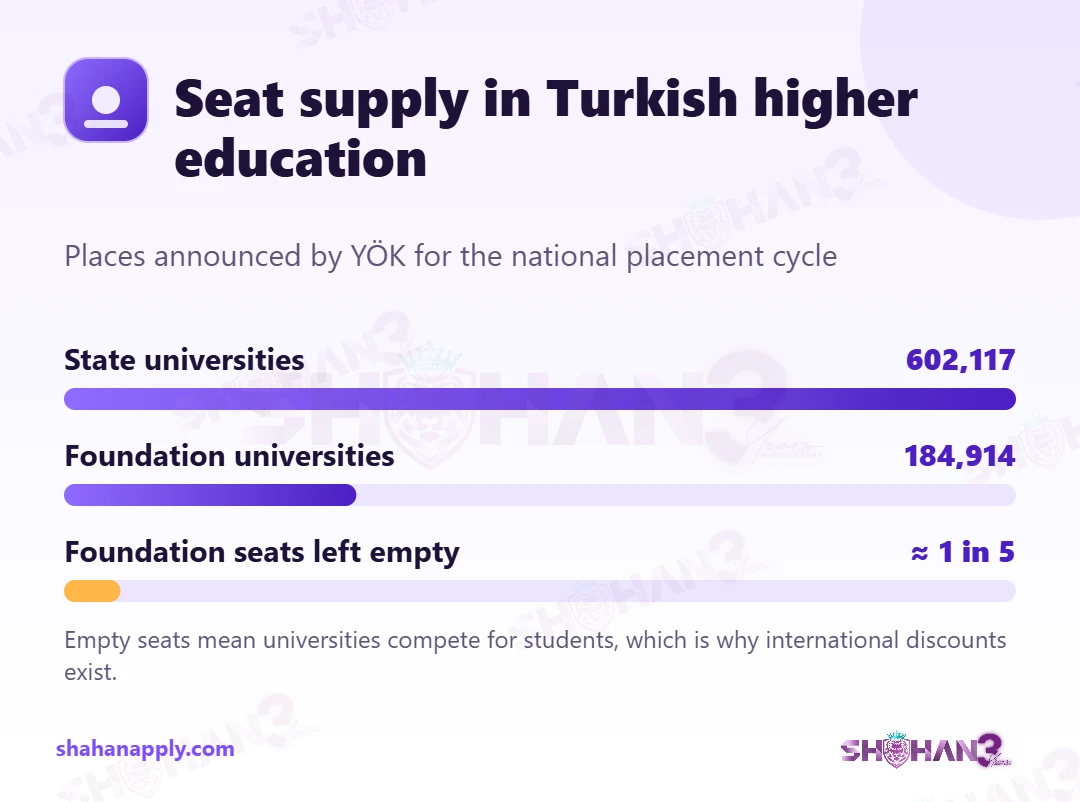
| Category | Places |
|---|---|
| State universities | 602,117 |
| Foundation universities | 184,914 |
| Foundation seats left empty in 2026 formal placement | 35,706 of 176,080 (about 1 in 5) |
How much do private universities in Istanbul cost?
The chart below shows the spread of annual bachelor’s tuition at a selection of Istanbul private universities, taken from our admissions fee database for the current intake. Each bar runs from the cheapest programme to the most expensive one at that university, which is usually medicine or dentistry.
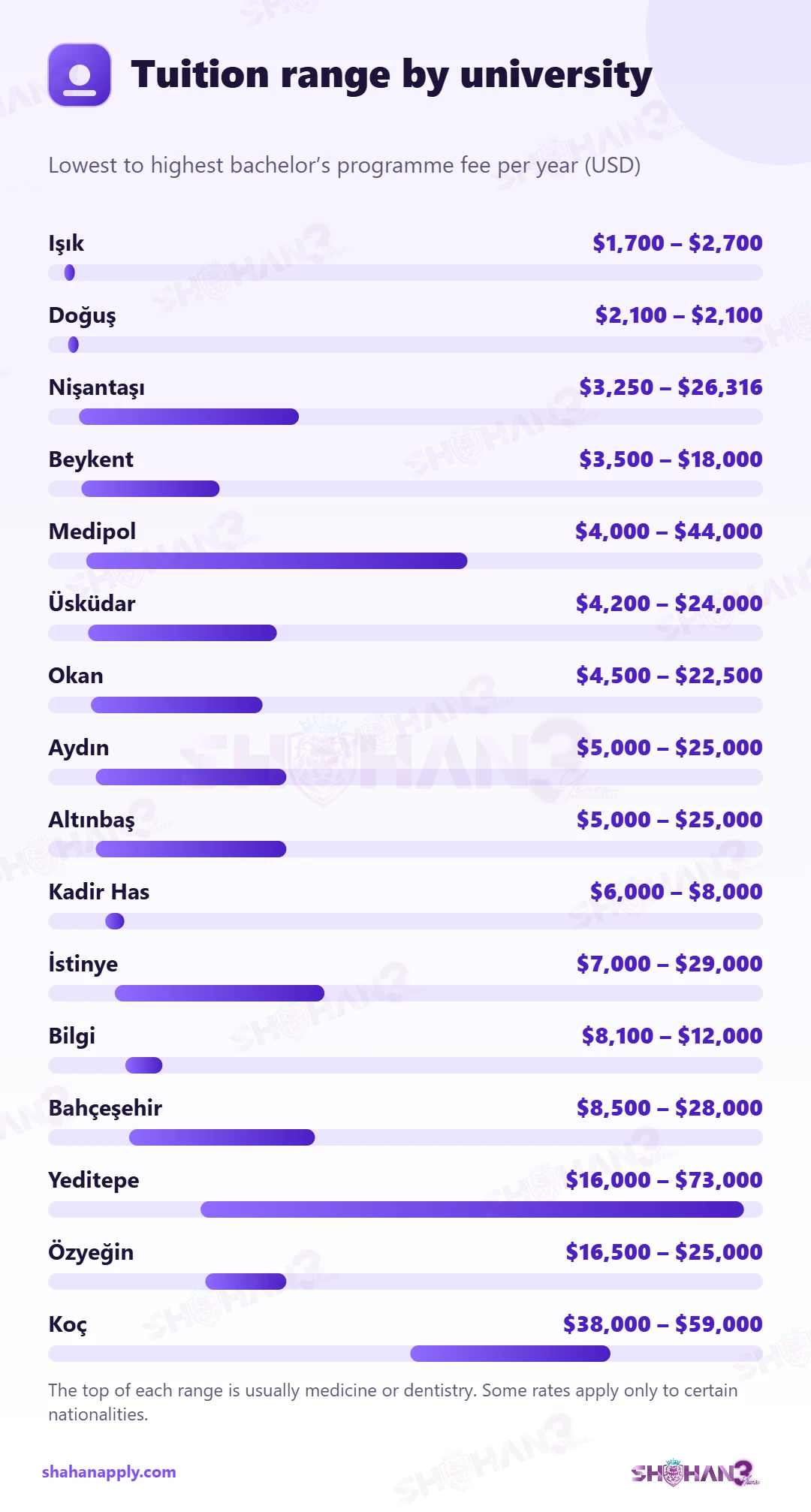
| University | Lowest programme | Highest programme |
|---|---|---|
| Işık | $1,700 | $2,700 |
| Doğuş | $2,100 | $2,100 |
| Nişantaşı | $3,250 | $26,316 |
| Beykent | $3,500 | $18,000 |
| Medipol | $4,000 | $44,000 |
| Üsküdar | $4,200 | $24,000 |
| Okan | $4,500 | $22,500 |
| Aydın | $5,000 | $25,000 |
| Altınbaş | $5,000 | $25,000 |
| Kadir Has | $6,000 | $8,000 |
| İstinye | $7,000 | $29,000 |
| Bilgi | $8,100 | $12,000 |
| Bahçeşehir | $8,500 | $28,000 |
| Yeditepe | $16,000 | $73,000 |
| Özyeğin | $16,500 | $25,000 |
| Koç | $38,000 | $59,000 |
Budget, mid-range and premium: what you actually get for the extra money
| Tier | Typical annual tuition | Examples | What the extra cost usually buys |
|---|---|---|---|
| Budget | under $5,000 | Işık, Doğuş, Topkapı, Arel, lower-priced programmes at Nişantaşı, Beykent, Gelişim | Affordable access, often newer or smaller campuses, more Turkish-taught options |
| Mid-range | $5,000–$12,000 | Aydın, Altınbaş, Kültür, Kadir Has, Fenerbahçe, Bilgi, Bahçeşehir (non-medical) | Wider English-taught catalogue, central or well-connected campuses, stronger international offices |
| Premium | $16,000–$40,000 | Yeditepe, Özyeğin, Sabancı | Smaller classes, research focus, selective admission, scholarship competition |
| Elite / medical | $20,000–$60,000 | Koç; English-taught medicine at Medipol, Yeditepe, İstinye, Bahçeşehir, Aydın | Hospital networks, clinical training, intense English-medium curricula |
Among private universities in Istanbul, a higher price does not automatically mean a better degree for you. If you plan to work in a field where employers care mainly about your skills and portfolio, such as software, design or digital marketing, a mid-range university with a strong internship network may serve you better than paying three times more. If you plan to practise a regulated profession at home, such as medicine, the decisive question is recognition in your country, not the campus.
How much can you save by applying through Shahan Apply?
Private universities in Istanbul work with authorised admission partners and often offer partner applicants a reduced annual fee. The table below compares the standard fee with the fee we can currently secure for applicants who register through us. These are real figures from our admissions fee database for the current intake, not estimates.
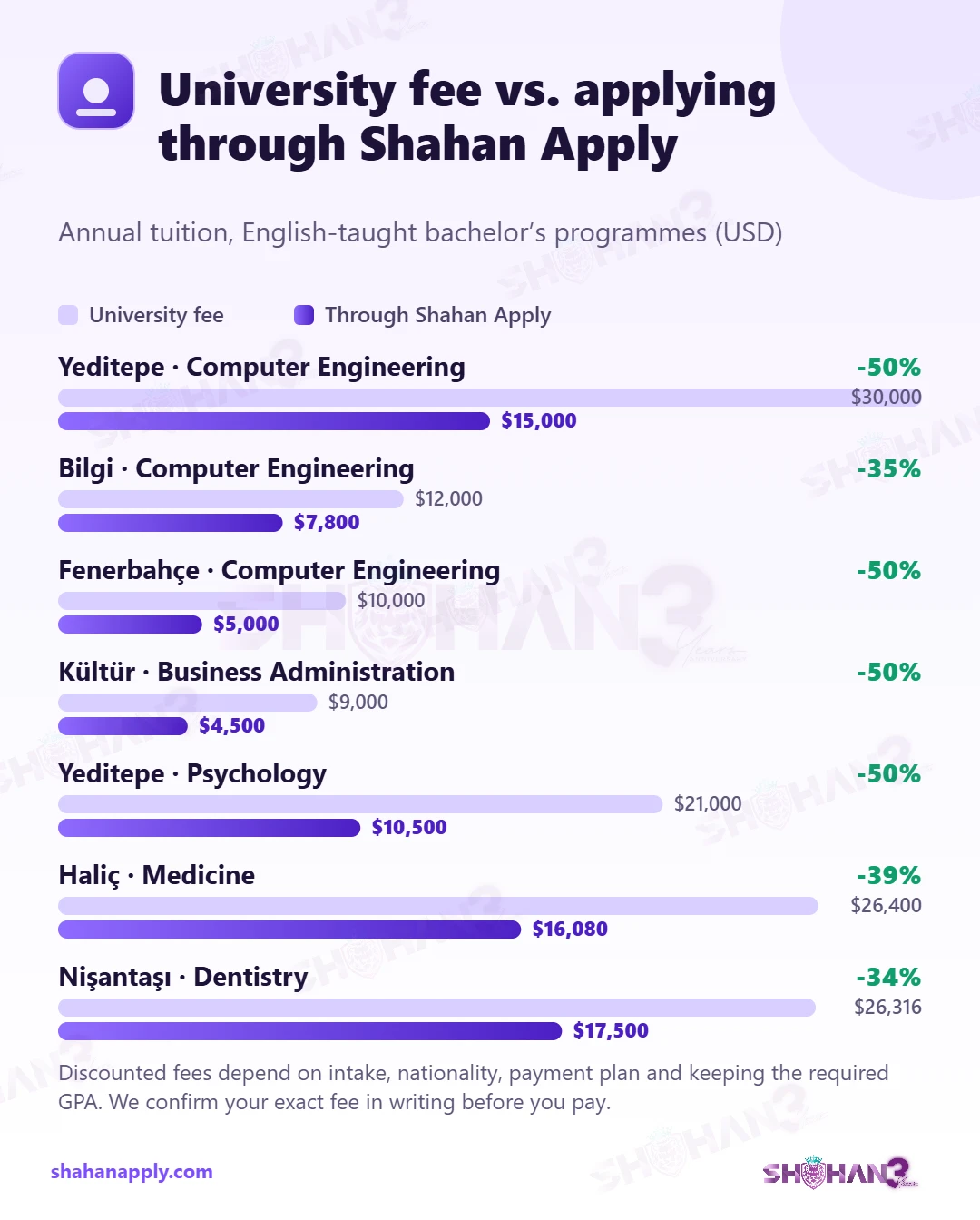
| University | Programme (English) | University fee / year | Through Shahan Apply | You save / year |
|---|---|---|---|---|
| Yeditepe University | Computer Engineering | $30,000 | $15,000 | $15,000 (50%) |
| Istanbul Bilgi University | Computer Engineering | $12,000 | $7,800 | $4,200 (35%) |
| Fenerbahçe University | Computer Engineering | $10,000 | $5,000 | $5,000 (50%) |
| Istanbul Kültür University | Business Administration | $9,000 | $4,500 | $4,500 (50%) |
| Yeditepe University | Business Administration | $18,000 | $9,000 | $9,000 (50%) |
| Ibn Haldun University | Psychology | $15,000 | $7,500 | $7,500 (50%) |
| Yeditepe University | Psychology | $21,000 | $10,500 | $10,500 (50%) |
| Istanbul Bilgi University | Architecture | $12,000 | $4,800 | $7,200 (60%) |
| Haliç University | Medicine | $26,400 | $16,080 | $10,320 (39%) |
| Yeditepe University | Medicine | $45,000 | $33,750 | $11,250 (25%) |
| Istanbul Nişantaşı University | Dentistry | $26,316 | $17,500 | $8,816 (34%) |
| Altınbaş University | Dentistry | $22,000 | $19,800 | $2,200 (10%) |
The real cost to enrol is more than tuition
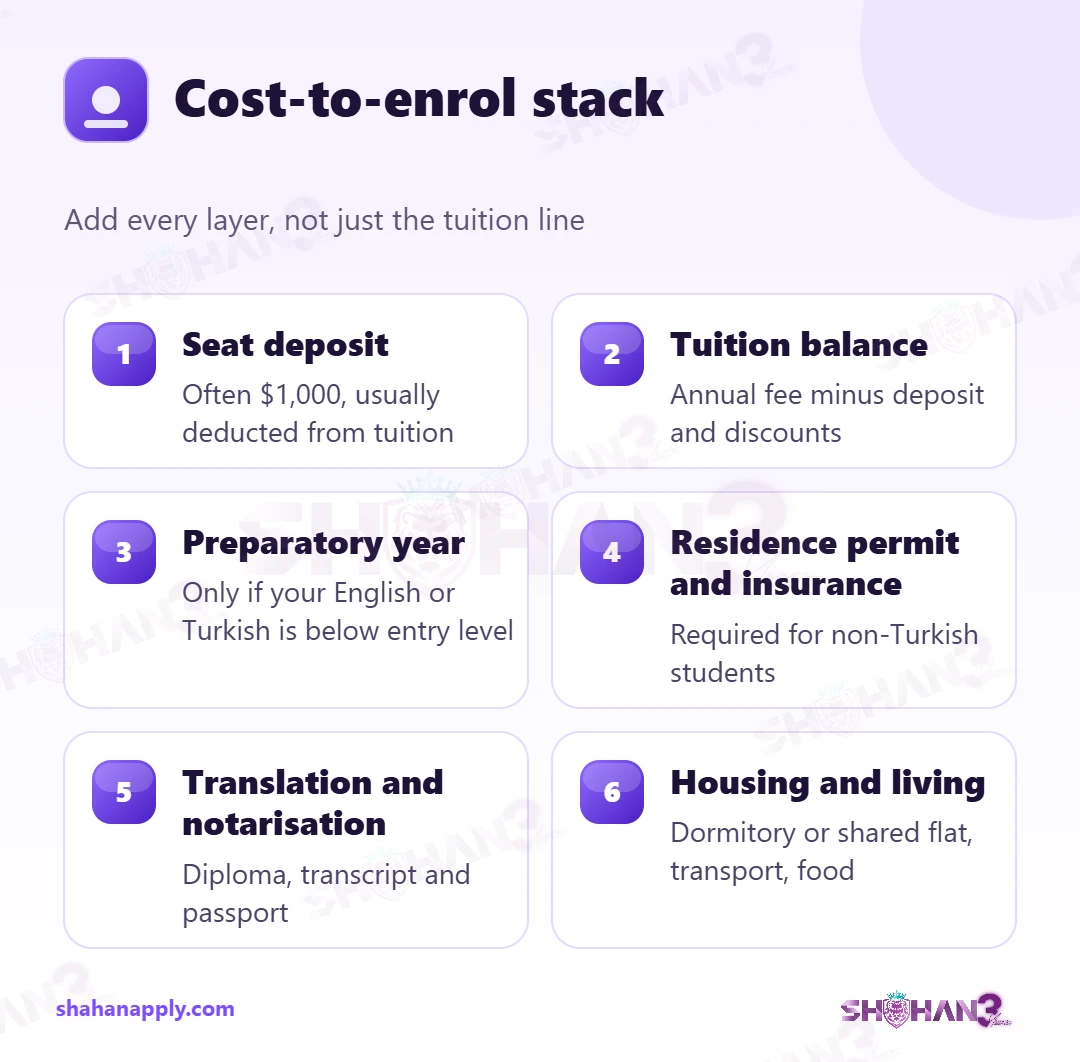
Families comparing private universities in Istanbul often budget for the tuition line and are surprised by the rest. In our fee database, the most common deposit at Istanbul private universities is $1,000, but some ask $2,000–$4,000, and a separate English preparatory year can cost anywhere from about $1,200 to $8,000 or more. Here is what to add up before you say yes.
| Cost | What it covers |
|---|---|
| Seat deposit | Often $1,000, usually deducted from tuition |
| Tuition balance | Annual fee minus deposit and discounts |
| Preparatory year | Only if your English or Turkish is below entry level |
| Residence permit and insurance | Required for non-Turkish students |
| Translation and notarisation | Diploma, transcript and passport |
| Housing and living | Dormitory or shared flat, transport, food |
We cover living costs and housing in separate guides. For the permit and insurance steps, see how our student residence permit support and health insurance for international students work, and use our certified document translation service if your papers are not in English or Turkish.
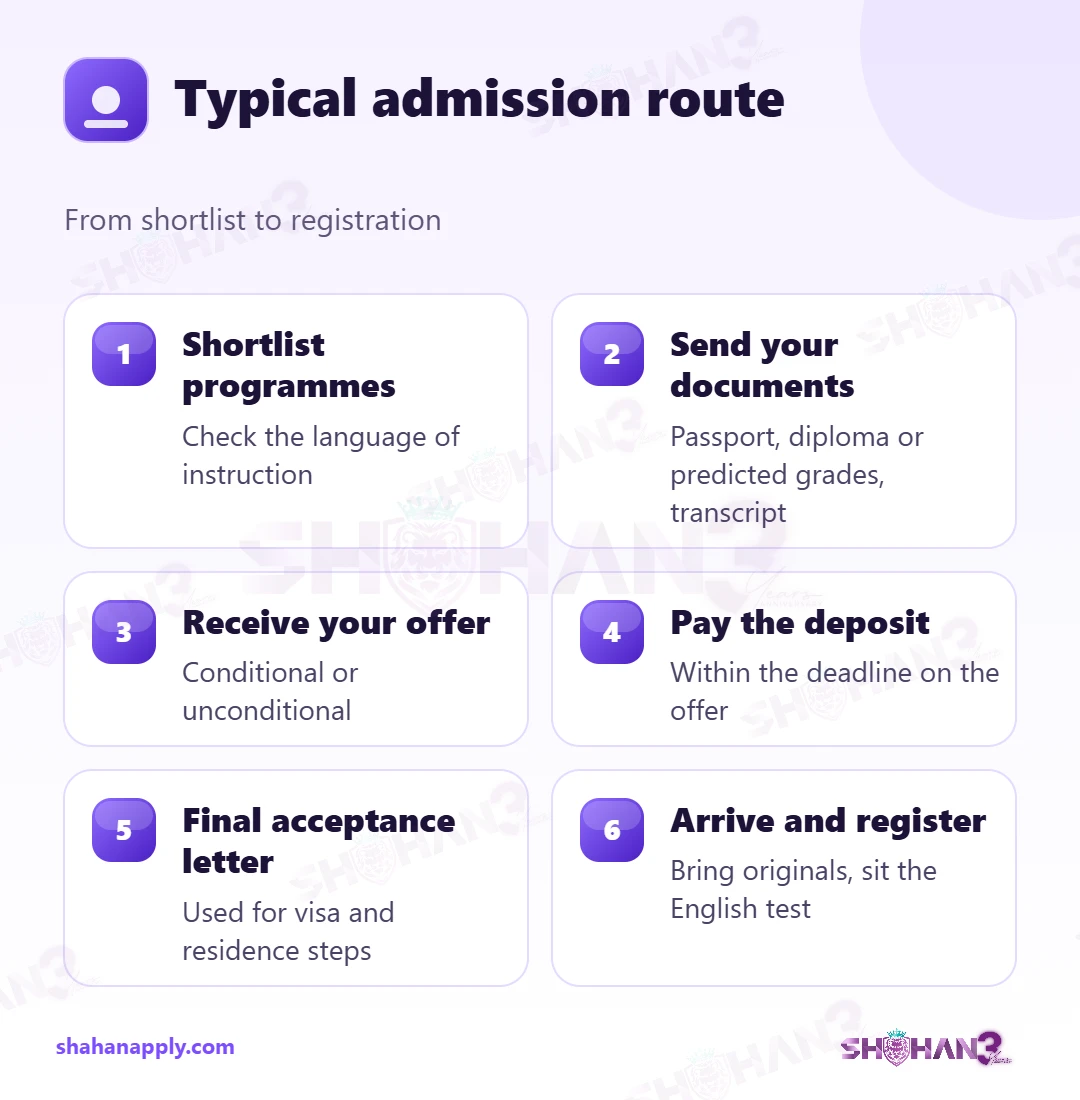
How do international students get admitted?
| Step | Action |
|---|---|
| 1 | Shortlist programmes and check the language of instruction |
| 2 | Send passport, diploma or predicted grades and transcript |
| 3 | Receive a conditional or unconditional offer |
| 4 | Pay the deposit within the deadline |
| 5 | Receive the final acceptance letter |
| 6 | Arrive, register with originals and take the English test |
The details that trip students up are rarely the big steps. They are small ones: a transcript that is not stamped, a diploma that still needs an equivalency (denklik) process, or an offer letter that lists a Turkish-taught programme when you expected English. Each of these can delay registration by weeks. If you want someone to check your file before you apply, our university admission service starts with a free eligibility review.
English, Turkish, or “30% English”?
Many private universities in Istanbul offer the same degree in more than one language. In our fee database you will see labels such as “English”, “Turkish” and “30% English”. A 30% English programme is mostly taught in Turkish. It is usually cheaper, but it only makes sense if you are ready to study in Turkish.
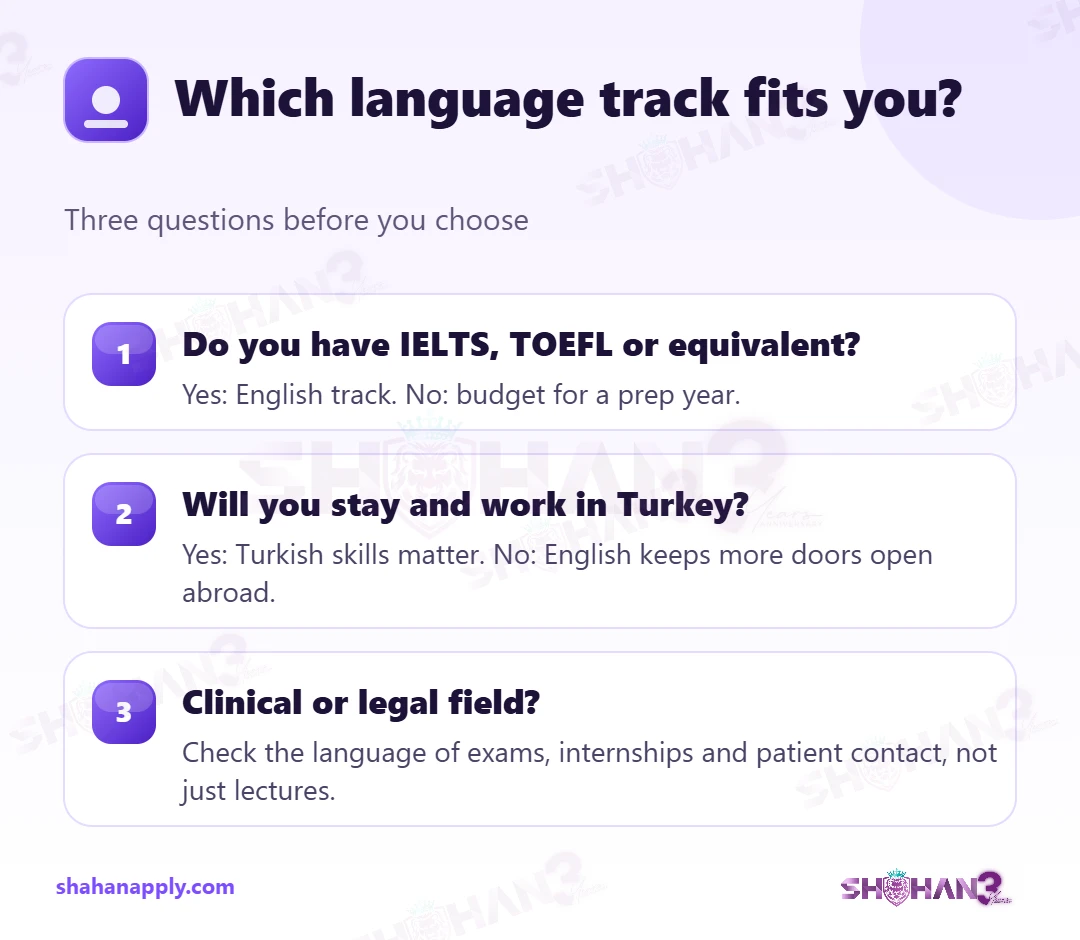
| Question | If yes | If no |
|---|---|---|
| Do you have IELTS, TOEFL or equivalent? | English track | Budget for a prep year |
| Will you stay and work in Turkey? | Turkish skills matter | English keeps more options abroad |
| Clinical or legal field? | Check exam, internship and patient-contact language | Lecture language is the main factor |
Is your university stable? A lesson from 2026
This is the part most “top 10” lists leave out. In May 2026, a Presidential Decree revoked the operating licence of Istanbul Bilgi University, a well-known private university, after trustees had been appointed to its founding foundation. Four days later, on 25 May 2026, a Presidential Decision repealed that revocation following a written request from YÖK, and the university continued operating, as YÖK announced. YÖK cited the interests of the university’s roughly 22,000 students.
Bilgi kept teaching, and we are not suggesting students avoid it. The point is broader: when you pay four to six years of tuition in advance, governance and financial stability are part of choosing between private universities in Istanbul. Hürriyet Daily News reported that Bilgi still had 40% of undergraduate seats unfilled in the 2026 placements, which shows how quickly uncertainty affects demand.
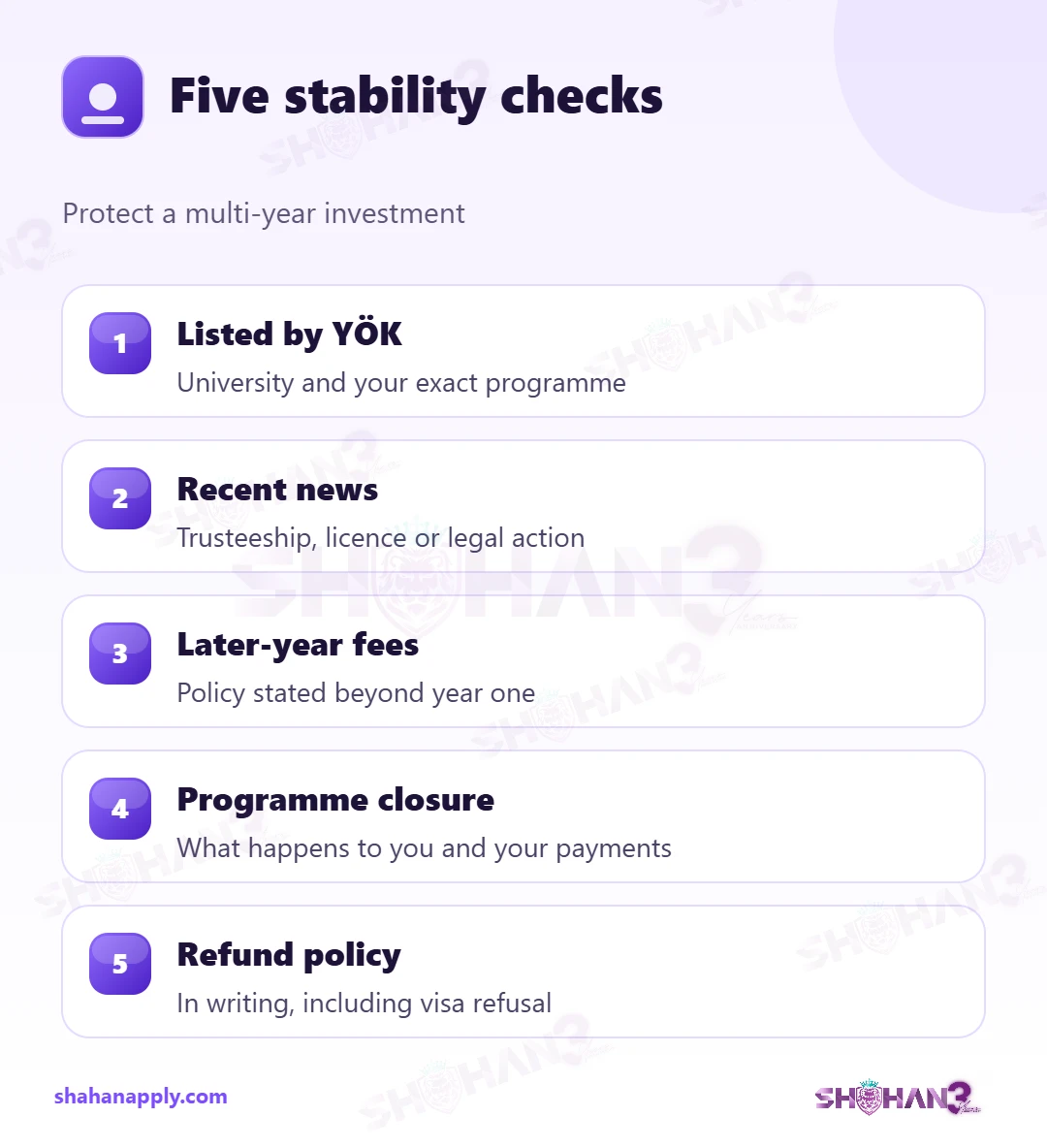
| Check | What to confirm |
|---|---|
| YÖK listing | University and exact programme are listed |
| Recent news | No trusteeship, licence or legal action |
| Later-year fees | Fee policy stated beyond year one |
| Programme closure | What happens to you and your payments |
| Refund policy | In writing, including visa refusal |
What should you check before paying a deposit?
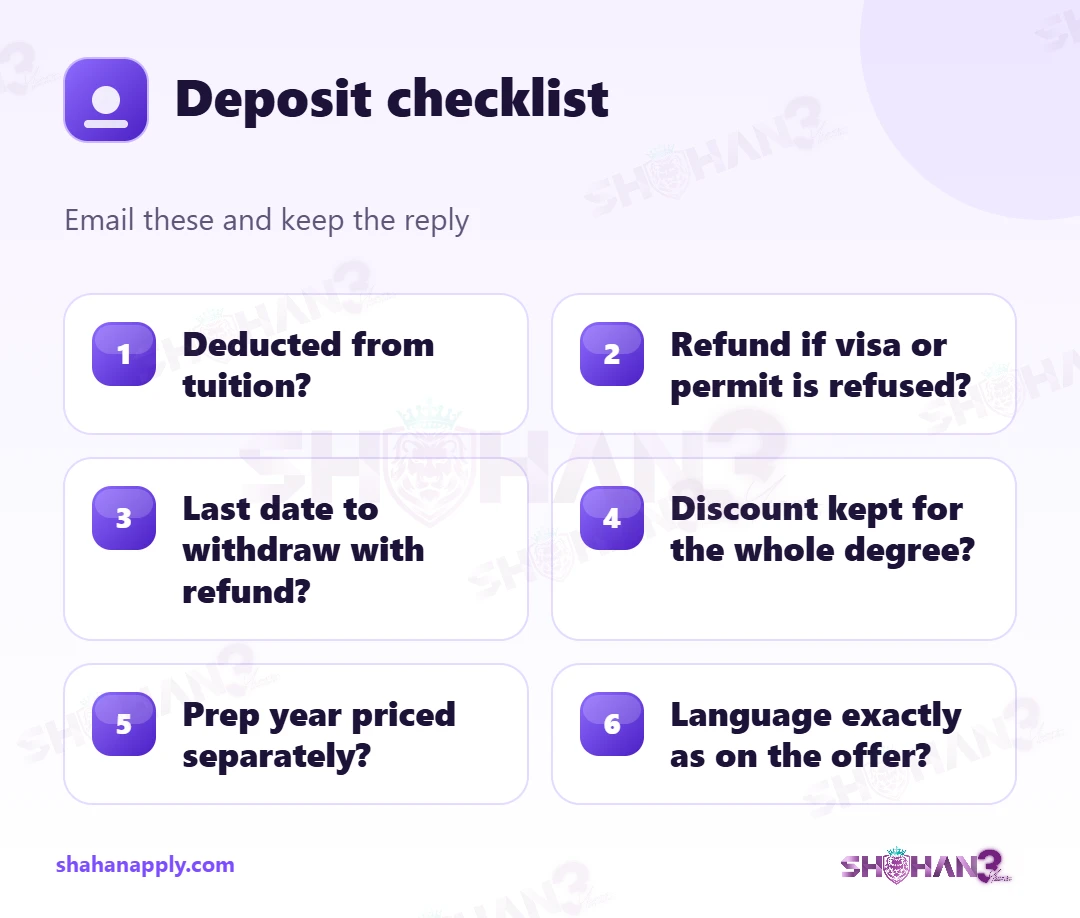
Here’s what I’d check before paying a deposit. These questions take one email to the international office of each of the private universities in Istanbul on your list, and the answers tell you a lot about how the university treats students once they have paid.
| # | Question |
|---|---|
| 1 | Is the deposit deducted from tuition? |
| 2 | Is it refundable if the visa or permit is refused? |
| 3 | What is the last date to withdraw with a refund? |
| 4 | Is the discount kept for the whole degree? |
| 5 | Is the prep year priced separately? |
| 6 | Is the language exactly as written on the offer? |
Find your price tier in 30 seconds
Use this quick tool to see which group of private universities in Istanbul fits your budget and field. It is a starting point, not an offer: final fees depend on the programme, intake and your nationality.
A worked example: building a shortlist of three
HypotheticalMeet Sara. She is 18, finishing school with good grades, has an IELTS score that meets typical entry levels, and wants computer engineering in English. Her family can pay about $7,000 a year for four years, and she wants the option of a master’s in Europe later.
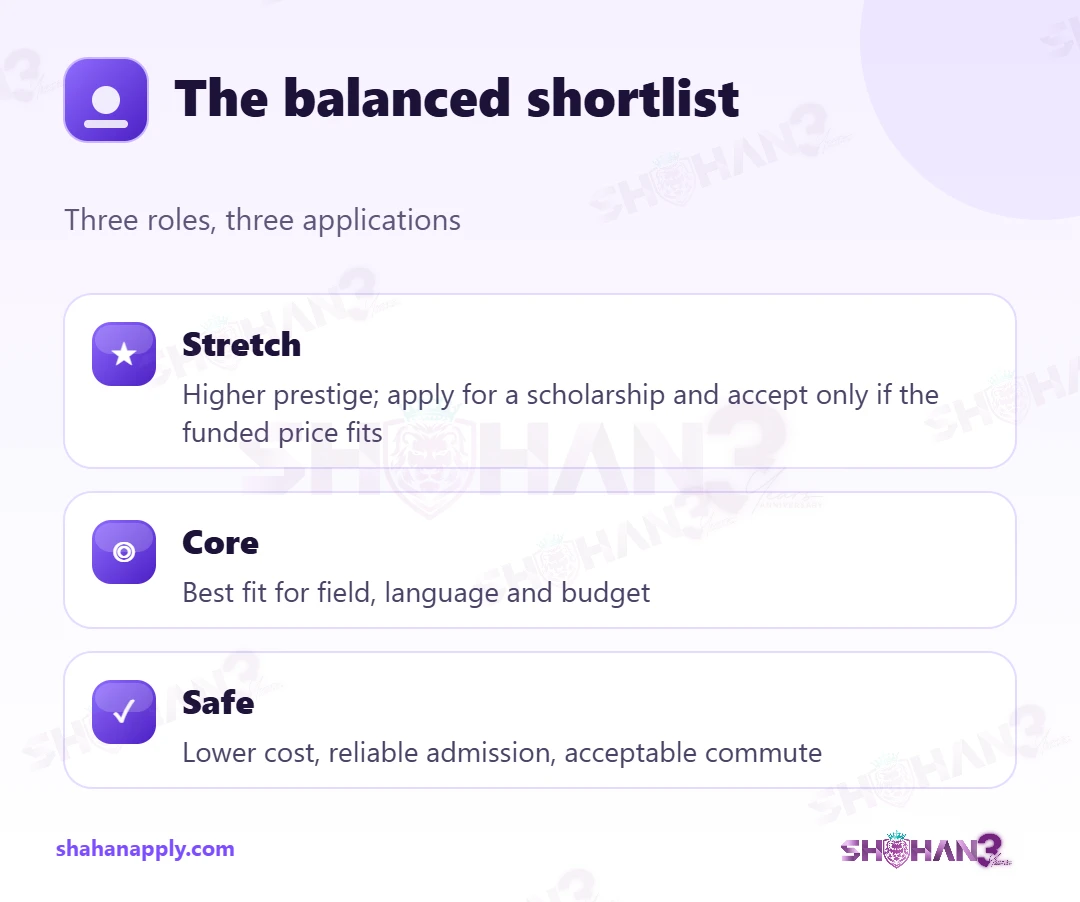
Her first instinct is to apply only to the most famous names. Koç and Sabancı are excellent, but their fees are several times her budget unless she wins a large scholarship. Rather than chasing one long shot, we would build her a balanced shortlist of private universities in Istanbul: one stretch option with a scholarship application, one strong mid-range university with an English-taught computer engineering degree inside her budget, and one safer, lower-cost option with good transport links to where she plans to live. For each, she would confirm the language of instruction, the discount for later years and the deposit terms in writing before choosing.
Why this path? Because the decision that most often goes wrong is not “which university is best” but “can we fund all four years without surprises”. A balanced shortlist protects Sara if her scholarship does not come through, and it keeps her European master’s plan open because all three degrees follow the Bologna credit structure.
| Role | Purpose |
|---|---|
| Stretch | Higher prestige; accept only if the funded price fits |
| Core | Best fit for field, language and budget |
| Safe | Lower cost, reliable admission, acceptable commute |
What can you do after graduating?
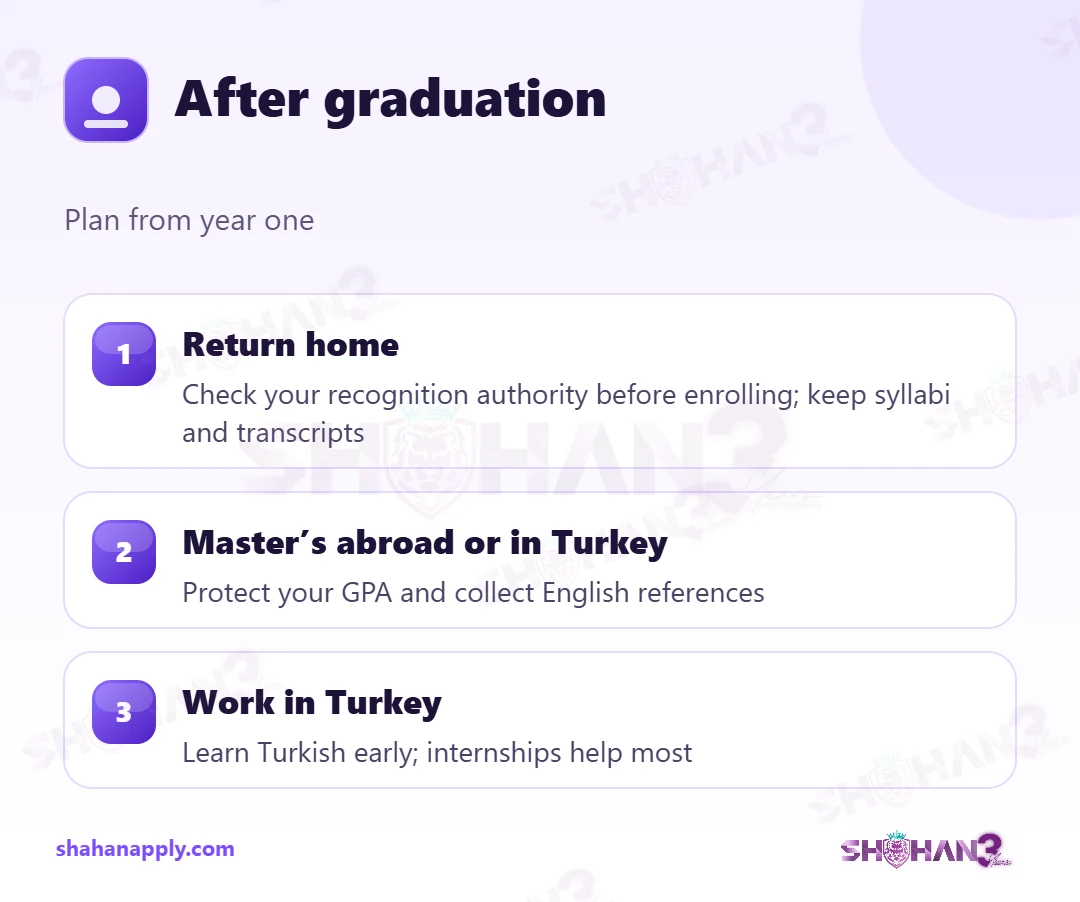
If you decide to go home after graduation, what happens next? For most degrees, you will need your country’s ministry or recognition body to recognise the Turkish diploma. Türkiye takes part in the Bologna Process, which helps with credit and degree-level comparisons in Europe, but recognition decisions are made by each country. For regulated professions such as medicine, dentistry, pharmacy, law or engineering licensing, permission to practise is a separate step from degree recognition.
| Pathway | What to do from year one |
|---|---|
| Return home | Check your recognition authority; keep syllabi and transcripts |
| Master’s abroad or in Turkey | Protect your GPA; collect English references |
| Work in Turkey | Learn Turkish early; do internships |
How to choose: our recommended path
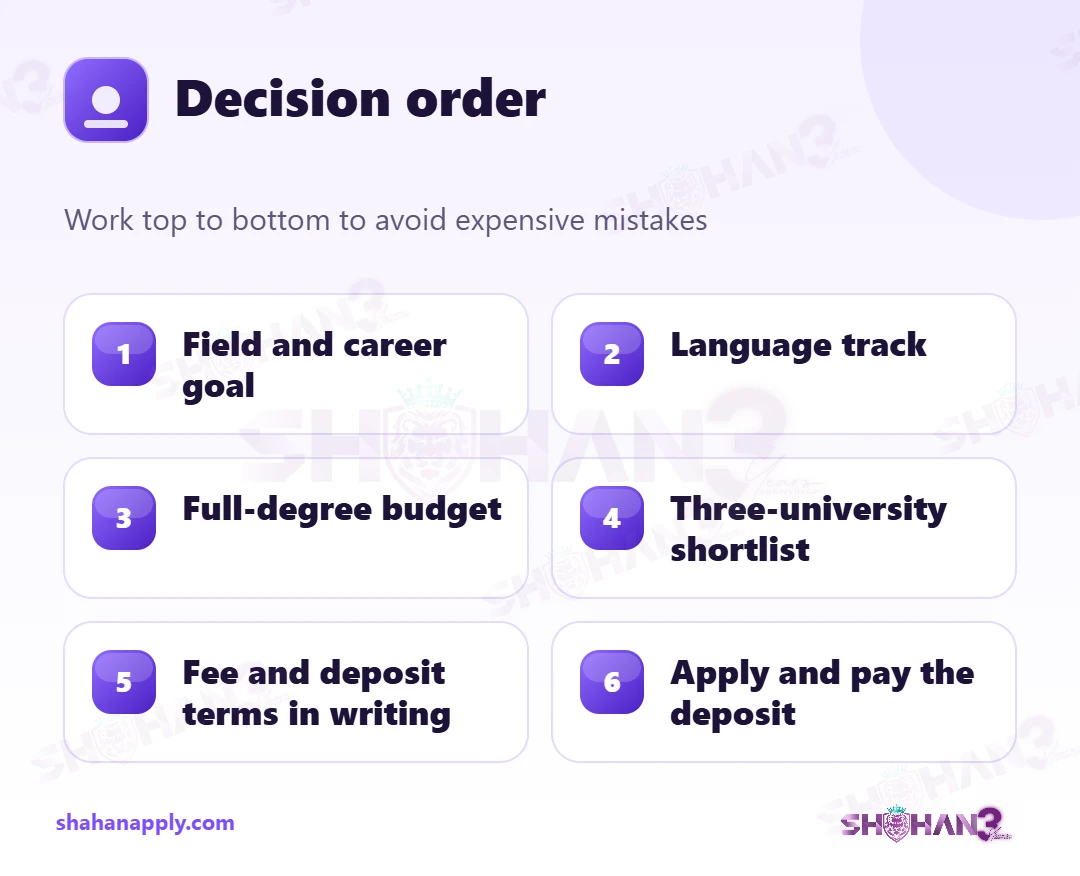
If you only remember one thing from this guide, make it this order of decisions when you compare private universities in Istanbul. Choose your field and language first, then set a full-degree budget, then shortlist universities, and only then compare campuses and rankings. Rankings of private universities in Istanbul are useful for research reputation, but they rarely change your day-to-day experience as much as language, class size and money.
| Step | Decision |
|---|---|
| 1 | Field and career goal |
| 2 | Language track |
| 3 | Full-degree budget |
| 4 | Three-university shortlist |
| 5 | Fee and deposit terms in writing |
| 6 | Apply and pay the deposit |
Frequently asked questions
Are private universities in Istanbul good?
Quality varies widely across private universities in Istanbul. A few, such as Koç, Sabancı and Özyeğin, are research-focused and selective. Many others are teaching-focused universities with good facilities and strong English-taught programmes. Judge each programme on its curriculum, accreditation, internship links and language of instruction rather than the “private” label.
What is the cheapest private university in Istanbul?
In our current fee database, the lowest annual bachelor’s fees start at around $1,700–$2,100 at universities such as Işık and Doğuş, and around $2,000–$3,500 at several others. The cheapest programmes are usually Turkish-taught or in social sciences. Check the latest figure in our Istanbul tuition fee table.
Can I get into a private university in Istanbul without YÖS?
Usually yes. Most foundation universities accept international applicants on their high-school diploma and grades. Some competitive programmes, especially medicine and dentistry, may ask for minimum grades, SAT, YÖS or their own exam, so confirm the rule for your exact programme.
Are degrees from private Turkish universities recognised abroad?
Foundation universities award degrees under the same YÖK framework as state universities, and Türkiye is part of the Bologna Process. Recognition in your home country is decided by your national authority, so check with them before you enrol, especially for regulated professions.
What is the difference between a private and a foundation university in Turkey?
There is no difference. “Foundation university” (vakıf üniversitesi) is the official term, and “private university” is the everyday English name for the same non-profit, fee-based institutions.
Is the deposit refundable if my visa is refused?
Policies differ by university. Many will refund or carry over a deposit if you can document a visa or residence refusal, but deadlines and deductions vary. Get the refund rule in writing before paying.
Your plan for today
- Choose your field and language track.
- Set a full-degree tuition budget, not a one-year budget.
- Gather your passport, latest transcript and English certificate if you have one.
- Shortlist three universities using the fee table.
- Email each international office the deposit checklist above.
Still comparing options? Let us review your eligibility and build your shortlist. Ready to apply? We will handle the application with you.
Get a free eligibility & shortlist reviewMessage us on WhatsAppExplore Shahan Apply
Sources
- Eurydice (European Commission): Types of higher education institutions in Türkiye
- Daily Sabah: Türkiye offers more than 805,000 university places for 2026
- Hürriyet Daily News: Trustee-hit Bilgi University sees mass placement vacancies
- YÖK: Istanbul Bilgi University to continue educational activities following Presidential Decision
- List of YÖK-accredited universities in Istanbul
- Istanbul.com (Arabic): الجامعات في إسطنبول
- Study in Türkiye – official portal
- Shahan Apply: Istanbul university tuition fee table
Fee ranges come from Shahan Apply’s admissions fee database for the current intake and from official university fee lists. Fees change every academic year and can depend on nationality and payment plan, so always confirm the figure with the university in writing. Shahan Apply does not guarantee admission, scholarships or recognition.